
Web3 Consensus Mechanisms: A Comprehensive Overview
With $4.1 billion lost to DeFi hacks in 2024, ensuring security in the blockchain world has never been more critical. Understanding the underlying systems that secure our digital assets is key to navigating this landscape safely. That’s where Web3 consensus mechanisms come into play. In this article, we will explore the various Web3 consensus mechanisms, their benefits and vulnerabilities, and how they shape the future of blockchain technologies.
What are Web3 Consensus Mechanisms?
Consensus mechanisms are the protocols or algorithms that allow nodes in a blockchain network to agree on the state of the blockchain. They provide the framework for validating transactions and securing the network. Essentially, they play a vital role in ensuring that all copies of the distributed ledger remain identical. As we transition into Web3, these mechanisms are evolving to promote decentralization and enhance security.
The Importance of Consensus Mechanisms
- Provide security: Prevent double-spending and ensure data integrity.
- Enable decentralization: Keep control away from a single authority.
- Ensure transparency: Foster trust among users by maintaining a verifiable record.
Types of Consensus Mechanisms in Web3
Several consensus mechanisms are utilized in today’s Web3 landscape. Each has its own strengths and weaknesses, tailored for different use cases.
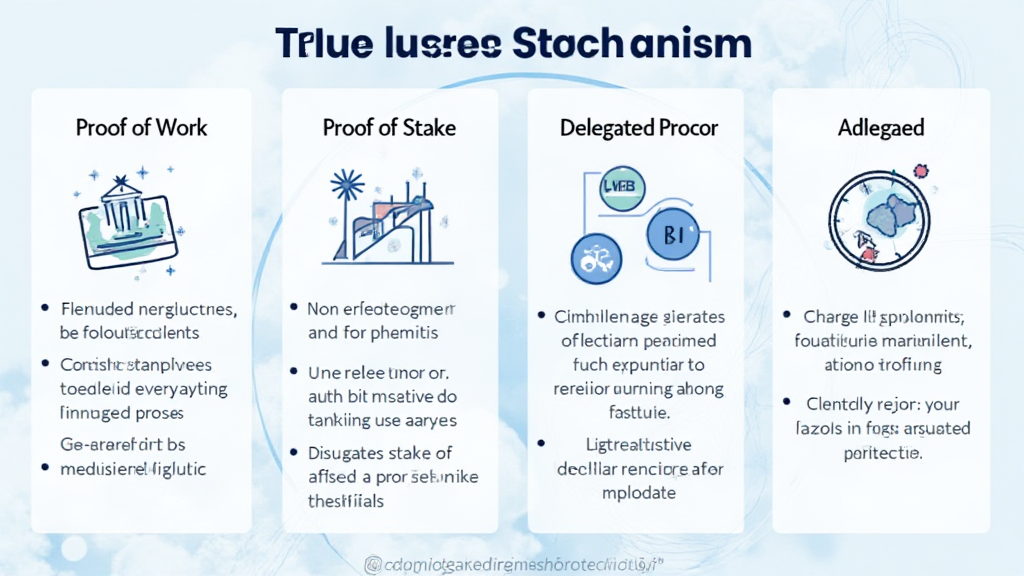
1. Proof of Work (PoW)
Proof of Work is the original consensus mechanism used by Bitcoin and is renowned for its high security:
- Functionality: Nodes, or miners, compete to solve complex mathematical puzzles to validate transactions.
- Energy-intensive: Requires significant computational power, leading to concerns about sustainability.
- Use Case: Primarily for cryptocurrencies like Bitcoin, where security is paramount.
2. Proof of Stake (PoS)
Proof of Stake addresses the energy consumption issues of PoW:
- Functionality: Validators are chosen based on the amount of cryptocurrency they hold and are willing to ‘stake’ as collateral.
- Lower energy use: Significantly less energy-intensive than PoW.
- Use Case: Ethereum’s move to version 2.0 is a pivotal example of PoS at work.
3. Delegated Proof of Stake (DPoS)
Delegated Proof of Stake further enhances the PoS model:
- Functionality: Holders vote for delegates or validators who will secure the network on their behalf.
- Engagement: Allows for faster transaction processing and greater scalability.
- Use Case: EOS and Steem employ DPoS to achieve high throughput.
Consensus Mechanism Vulnerabilities
No consensus mechanism is without its flaws. Each type presents its own unique challenges:
- PoW: Vulnerable to 51% attacks, where a group of miners gain control of the majority of the network’s computational power.
- PoS: Risks becoming centralized if wealth concentration occurs, leading to oligarchic networks.
- DPoS: Potential for collusion among delegates, undermining the decentralization ethos.
Real-World Applications of Consensus Mechanisms
As we delve into the practical implications, let’s examine how these mechanisms are implemented in real-world projects:
- Bitcoin: Utilizes PoW to secure its decentralized currency.
- Ethereum: Transitioning from PoW to PoS aims to improve scalability and reduce its carbon footprint.
- Cardano: Works on a unique variation of PoS, allowing for a more democratic participation scheme.
Vietnam’s Growing Interest in Web3 Technologies
Vietnam has seen a surge in interest in blockchain technology, with user growth rates skyrocketing. In 2023, the growth rate of Vietnamese crypto users reached 120%, highlighting the nation’s eagerness to adopt Web3 solutions. According to recent surveys, 65% of young Vietnamese respondents expressed interest in investing in cryptocurrencies. As local businesses explore blockchain applications, the role of consensus mechanisms becomes increasingly relevant.
Future Trends in Web3 Consensus Mechanisms
Looking ahead, several trends are shaping the future of Web3 consensus mechanisms:
- Hybrid Models: The blend of PoW and PoS seeks to combine security and efficiency.
- Scalability Solutions: Layer 2 solutions aim to improve transaction speeds while maintaining lower costs.
- Greater Regulation: As countries develop clearer frameworks for cryptocurrencies, consensus mechanisms will adapt to meet compliance.
Conclusion
As the digital asset landscape evolves, so too do the consensus mechanisms that underpin it. Understanding these mechanisms—whether it’s PoW, PoS or DPoS—is essential for anyone navigating the world of blockchain and cryptocurrencies. The implications for security, decentralization, and user engagement are profound, especially as markets like Vietnam grow rapidly. By staying informed, investors and developers alike can harness the full potential of Web3 technologies, ensuring a secure and efficient future.
For more insights and updates in the crypto space, visit cryptosalaryincubator.
Written by Dr. Alex Nguyen, a blockchain technology expert with over 10 published papers in the domain and a lead auditor on various high-profile projects.